
24/7 EMERGENCY HOTLINE
(610) 918-9698
(610) 918-9698

Emergencies evolve—and so should your response plan. Our Priority Response Program is reviewed annually to keep contacts, procedures, facility changes, and emergency protocols current, ensuring your team and ours are ready before the next water, sewer, mold, or fire event.

When water, mold, fire, or contamination hits your building, closing the doors isn’t an option. You have patients to care for, students to teach, and people counting on you to keep things running. Every hour you’re offline is an hour of pressure you don’t need — on your team, your budget, and your good name.
County Action Restoration keeps you open. We build a continuity-first plan that looks after your people, protects your critical equipment, and keeps your essential operations moving while our specialists handle the cleanup and repairs. You focus on the work only you can do. We’ll take care of the rest.
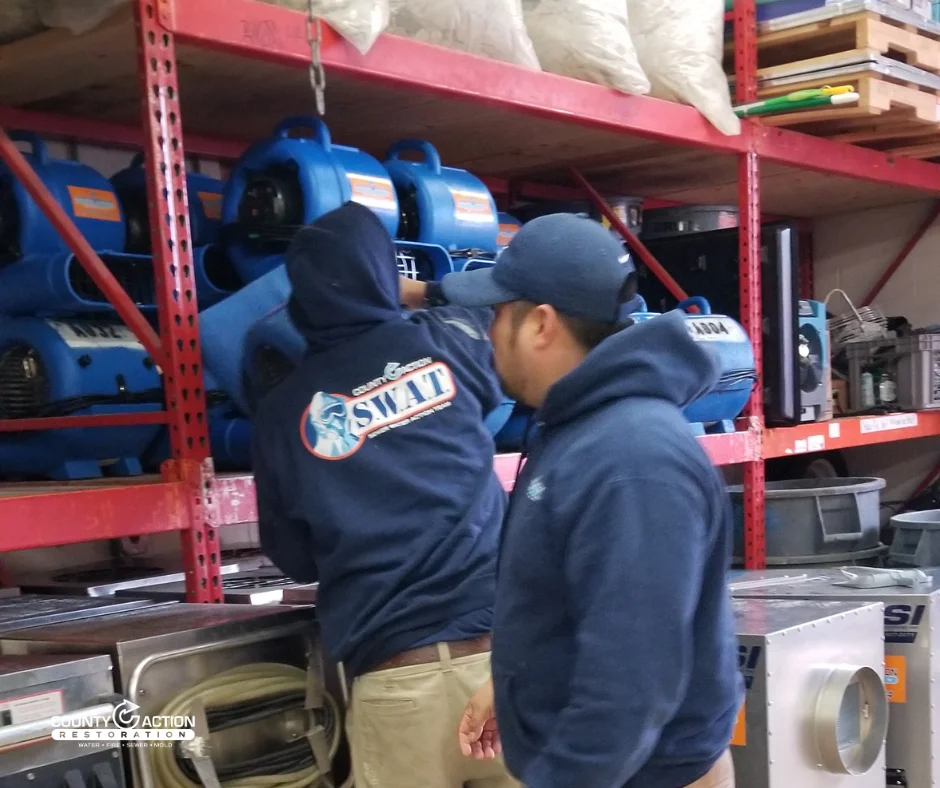
We plan every project around your operation, not the other way around. Here’s how we keep the interruption to a minimum.

Before we touch anything, we sit down with you to confirm who makes the calls, how issues get escalated, which areas stay off-limits, and how we’ll keep everyone in the loop. No surprises, no guesswork.

Using containment barriers, HEPA filtration, and negative pressure, we seal off the restoration area so it stays separate from the spaces you’re still using. In healthcare settings, infection control leads every decision we make.

Noisy or higher-risk work happens when it disrupts you least, after hours, between classes, or around patient-care schedules. Your routine keeps moving while we do the heavy lifting.

We coordinate utility isolation and safeguard your critical systems, from medical devices and servers to records and sensitive equipment. The things that keep you running stay safe.

Daily moisture readings, photos, access changes, equipment placement, and scope updates all go on record. You get a clear, defensible account of the entire project.
For us, success isn’t just about hauling equipment out the door quickly. It’s about keeping your facility doing what it was built to do.
That’s why we help you answer the questions that really matter:
For healthcare facilities, that may also mean working alongside your infection prevention team and completing formal infection-control risk assessments.

Our goal goes beyond restoring a building. It’s about protecting the operation that building exists to support — the people, the care, the learning, the work that can’t stop.


Most restoration companies see damaged rooms. We see the operations happening inside them.
That difference matters more than you might think. A flooded imaging suite isn’t just a wet floor. It throws off patient scheduling. A mold problem in an elementary school doesn’t just close a room. It shrinks classroom capacity. And a broken sprinkler line in an office tower? That ripples out to dozens of businesses, leased spaces, elevators, IT systems, and building access all at once.
The physical damage is only part of the story. The real question is how your building keeps functioning while the work gets done.
Answering that means balancing five goals at the same time:
Here’s the tricky part: those goals often pull in different directions. The fastest way to tear out damage isn’t always the safest choice in an occupied hospital. The quickest drying setup might mean placing equipment where it blocks an emergency exit, patient movement, or the flow of students between classes.
So real restoration becomes an exercise in operational risk management and not just construction. That’s the mindset we bring to every critical facility.
A lot of restoration companies run the same playbook no matter what building they’re in. We don’t. We build our plans around how your facility actually operates, because a hospital, a school, and an office tower each carry very different pressures.

Healthcare settings demand restoration that supports infection prevention, patient safety, and clinical operations that simply can’t pause. Before we lift a tool, we work through questions like:
Our approach builds in infection-control measures — containment, directional airflow, and close coordination with your infection-prevention team. It’s an approach that reflects the strengthened infection-control planning The Joint Commission emphasizes for healthcare facilities.

Schools run on predictable rhythms, and good restoration respects them wherever it can. Instead of shutting down an entire wing, we phase the work around your day:
Noisy work waits until after dismissal. And when students are still in the building, air quality monitoring becomes a top priority. Our goal is to keep learning going — not just to dry out the building.

Office buildings bring their own kind of pressure. So much depends on systems that can’t skip a beat:
We sequence the work to keep disruption low for your employees while protecting confidential information, technology infrastructure, and tenant operations. Sometimes that means working overnight. Sometimes it’s restoring one suite at a time. And sometimes it means setting up temporary workspaces while mitigation continues nearby.
Whatever your building demands, we plan around it — so you can keep doing what you do best.
Before we ever roll in a single piece of equipment, we ask one simple question: What absolutely cannot stop?
That question changes everything. It’s what separates a crew that dries a building from a team that protects the operation inside it. At County Action Restoration, we map out your critical dependencies first so our plan works around them, not through them.
Here’s what we look for.

come first, because these keep everyone inside protected:

keep your spaces safe and stable:

keep your business connected:

keep your day moving:
Once we understand which of these can’t skip a beat, the whole plan takes shape around them. It guides where we place containment, when it’s safe to shut down utilities, and how we sequence the rebuild. The result is restoration that respects what keeps you running so the work gets done without putting your operation at risk.
Here’s something most people never expect: the biggest disruptions during a restoration project don’t come from the demolition itself. They come from movement.
Think about everything that’s in motion once a project starts.
People move. Equipment moves. Waste moves. Contractors move. Patients move. Students move. Employees move.
And every single one of those movements is a chance for contamination to spread or for daily operations to grind to a halt.
That’s why County Action Restoration builds detailed circulation plans before the work begins. These plans map out exactly how everyone and everything travels through your space.
The paths your occupants use every day—carefully kept separate from any restoration activity, so people can go about their business without walking through the work zone.
Dedicated pathways just for debris removal, demolition materials, and contaminated equipment. This keeps the mess where it belongs and away from clean areas.
Designated spots where dehumidifiers, air movers, extraction hoses, generators, and temporary power can run at full capacity without getting in anyone’s way.
Fire exits, ambulance access, delivery entrances, and ADA pathways stay open and available for the entire project. No exceptions.
Honestly, very few restoration companies even talk about circulation planning. But when a building stays occupied during the work, it’s often the one thing that decides whether the whole project succeeds or turns into a headache.

There’s a common assumption that when part of a building gets damaged, that whole department has to shut down. The good news? That’s usually not the case.
More often than not, a skilled restoration team can keep things running by coordinating temporary operational adjustments. It’s all about working around the damage instead of stopping everything in its tracks.
Here’s what that can look like in practice:
The beauty of these adjustments is simple: they keep your doors open. Instead of shutting down and losing days or weeks of operation, you keep serving people while the restoration work happens around them. That kind of planning can cut business interruption dramatically—and that’s exactly what keeps a project moving smoothly for everyone involved.
County Action Restoration evaluates restoration decisions using more than construction criteria.
Rather than pursuing the fastest restoration at any cost, we help facility leadership select the approach that best balances safety, operational continuity, schedule, and budget.
On occupied commercial projects, silence is expensive. When people don’t know what’s happening, confusion spreads fast—and honestly, poor communication can cause nearly as much disruption as the water, fire, or mold that started it all.
That’s why County Action Restoration treats communication like the essential tool it is. From day one, we keep everyone in the loop with clear, predictable updates. No guessing. No surprises.
At every stage, your stakeholders know exactly:
The result? A lot less uncertainty. When your facility leadership knows what’s coming, they can make smart, informed decisions and keep operations steady while the work moves forward.
Here’s where many restoration companies stop short. They rebuild exactly what was there before the loss—same materials, same layout, same weak points. And that means the next emergency can hit just as hard as the last one.
We take a different approach. County Action Restoration looks at reconstruction as a chance to make your facility tougher. While we’re rebuilding, we ask a simple question: how do we make the next incident less disruptive?
The goal isn’t just putting your facility back together. It’s making sure the next emergency is smaller, shorter, and far less painful than the last.
Don’t wait for the next disaster to expose the weak points in your building. Partner with a restoration team that keeps you informed every step of the way and rebuilds your facility stronger than before.
Contact County Action Restoration today for a consultation. Let’s keep your operations running, your people safe, and your facility ready for whatever comes next.
