(610) 918-9698
(610) 918-9698
Our structural drying service checks for hidden moisture, monitors drying daily, and documents progress so you know when your property is fully dry.
Water damage doesn’t stop when the standing water is gone. Moisture keeps hiding where you can’t see it, inside drywall, subfloors, framing, insulation, flooring systems, and wall cavities. Leave it there, and it turns into warping, rot, and mold before you ever know something’s wrong.
At County Action Restoration, we don’t just set up fans and dehumidifiers, cross our fingers, and hope for the best. We treat structural drying as a measured, data-driven process because guessing isn’t good enough when your home is on the line.
Our RIA and IICRC-certified technicians pinpoint exactly where moisture has traveled, set the right drying conditions, and measure progress every step of the way. The moment the data says to adjust, we adjust. And we document every result, so you never have to wonder if it’s dry. You’ll know it is.
Structural drying takes know-how. We track where the water traveled, identify which materials soaked it up, understand how those materials release moisture, and confirm the drying environment is actually pulling it out. Miss one of those, and moisture stays trapped where you can’t see it, and mold will develop.
We pair professional moisture-detection equipment with commercial dehumidification, controlled airflow, and constant measurement to manage every stage of the process. Nothing is left to chance.
Because the goal was never to make a room feel dry. The goal is to pull excess moisture out of your building materials and back it up with hard numbers, so you and your insurance know it’s done right.
Structural drying is the careful, controlled removal of excess moisture from your building materials after water gets where it shouldn’t. Think of it as the deep, thorough dry-out that happens long after the visible water is gone. Depending on what happened, moisture can work its way into:
Water extraction and structural drying are not the same thing. Extraction pulls out the bulk water that you can see and mop up. Structural drying handles everything extraction leaves behind.
Moisture doesn’t just sit still and wait. It slips under your flooring, soaks through porous materials, and hides in spaces that look perfectly fine from the outside. You’d never know it’s there until the warping, rot, or mold shows up weeks later. By then, a small problem has become a big one.
That’s exactly why proper structural drying matters. We find that hidden moisture and dry it out completely, so a hidden problem never gets the chance to become a costly one.
Throughout the entire job, our technicians take moisture and atmospheric readings, checking the numbers again and again to see exactly where things stand. And when those numbers stall or move the wrong way? We dig in, figure out why, and track it down and adjust.
That’s the difference we make. Our drying plan follows what’s actually happening inside your property: the real conditions, the real readings, never some set number of equipment-rental days decided ahead of time. We stay until the numbers say you’re truly dry. Not a day longer, not a day too soon.
The visible wet area rarely reveals the complete picture. Water travels well beyond what the eye can detect, penetrating materials and cavities that appear entirely dry on the surface.
Our process begins with a thorough evaluation of every affected material, supported by professional moisture-detection equipment that maps the true extent of the intrusion. Before any drying takes place, we determine precisely what is wet.
Once we identify where the water has traveled, we record initial moisture and atmospheric readings to give our technicians a clear reference point.
These measurements do more than document a figure. They allow us to assess each affected material and develop a drying strategy tailored to your site’s actual conditions, rather than a generic, one-size-fits-all template.
When standing or extractable water remains, we remove it before restorative drying begins.
Extracting bulk water quickly lets the structural drying process focus on what matters most: moisture retained deep within your building materials.
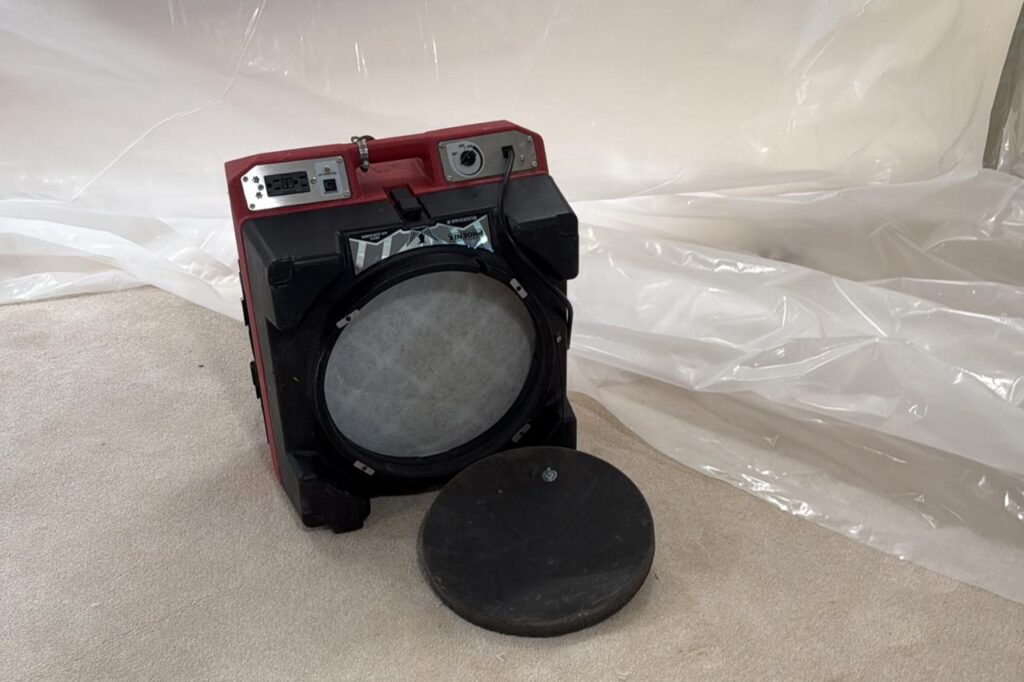
Next, we establish the conditions that make effective drying possible. Commercial air movers accelerate evaporation from wet materials, while professional dehumidifiers extract that moisture from the surrounding air.
Our equipment placement is never arbitrary. We position each unit according to the affected materials, the size and layout of the loss, and the specific conditions our technicians identify on site.
Throughout the project, we take ongoing moisture and humidity readings to confirm that materials are drying as expected.
This is the distinction between professional structural drying and simply leaving equipment running. We track measurements at every stage, ensuring we can always demonstrate progress.
Drying does not always follow a predictable, linear path, and we are fully prepared for that reality.
When readings indicate that progress has stalled, we respond immediately. We refine airflow, equipment placement, dehumidification, or containment based precisely on what the measurements reveal. No delays. No guesswork. Only decisions guided by data.
Equipment should never determine when a job is finished. Measurements should.
Once every affected material reaches our established drying goals, we complete comprehensive project documentation, including photographs, moisture data, and drying logs. You are left with clear, verifiable proof that the work was performed correctly.
Hidden moisture ranks among the greatest risks following any water loss, and it is frequently the one property owners never anticipate. Water follows gravity, absorbs into porous materials, and settles into concealed spaces you would never think to examine.
The evidence is not always apparent:
That’s why we never base drying decisions on a visual inspection alone. We measure what is occurring inside the materials themselves, because that is where the genuine damage hides and where lasting problems take hold.
Structural drying is best understood as a measurable process, one with a defined start, documented progress, and a verifiable finish. Every stage can be confirmed with data rather than assumption.
Without consistent monitoring, you’re left to guess at the questions that matter most:
We answer each of these questions with precise moisture and atmospheric measurements taken throughout the entire project. There’s no guesswork and no reliance on whether something simply feels dry. At every step, the data drives the decision, giving you confidence that the work is complete and the results can be proven.
Since 1992, we have specialized in water damage and mold inspection and restoration, which means we understand firsthand what happens when moisture goes unaddressed.
We are regularly called into buildings where an overlooked moisture problem has already developed into mold. That experience informs how we approach every water loss.
Combining water-damage restoration with genuine mold expertise gives us a sharper, more complete perspective on structural drying. Our objective is not simply to complete the dry-out. It is to ensure today’s water loss never becomes tomorrow’s hidden mold problem.
In many cases, effective structural drying allows us to preserve affected materials rather than removing them unnecessarily. Whether a material can remain in place depends on several factors:
We evaluate these real-world conditions before determining the right approach. We do not remove materials simply because they became wet, and we do not preserve materials when removal is clearly warranted. The decision rests on the material’s condition and whether it can be properly restored.
Contact County Action Restoration for professional structural drying following any of these events:
Once water reaches porous building materials, removing the visible water is never enough. The sooner you act, the sooner you contain the damage before it spreads and turns a manageable issue into a costly one.
A minor leak inside a home often causes far more damage than what appears on the surface. Water from an upstairs bathroom, for example, can migrate into flooring, subflooring, the ceiling below, insulation, and neighboring wall cavities all from a single overlooked drip.
We trace the complete path of the water, not merely the point where the leak first became visible. This thorough approach ensures no trapped moisture is left behind to cause problems later.
We deliver professional structural drying for houses, condos, apartments, and other residential properties throughout southeastern Pennsylvania, New Jersey, and Delaware.
Water damage in a commercial property carries an added risk: business disruption. Every hour your operation sits offline has a real cost.
We provide fast, reliable structural drying for offices, multifamily properties, retail spaces, hospitals or medical facilities, and other commercial buildings. Our measurement-driven process gives owners and managers clear, dependable answers on:
That same detailed documentation proves invaluable when a water-loss insurance claim is involved, giving you verifiable records to support the process from start to finish.
Exceptional restoration services and specialty cleaning in Southeast Pennsylvania, Delaware, and New Jersey. Our mission is to surpass your expectations with our best workmanship and unwavering dedication.
There is no universal timeline that applies to every water loss. Drying duration depends on the materials involved, the volume of water, environmental conditions, accessibility, and how those materials respond throughout the process. That’s why County Action Restoration relies on moisture readings rather than an arbitrary schedule. We continue until the measurements confirm the structure has reached its drying goals.
Water extraction removes standing and bulk water from a property. Structural drying addresses the moisture that remains trapped inside building materials once extraction is complete. Both steps are essential, but they solve different problems. Extraction handles the water you can see, while structural drying handles the moisture you cannot.
Household fans move air, but professional structural drying requires far more than airflow alone. An effective drying environment must control humidity and moisture movement while precise measurements confirm genuine progress. Consumer-grade fans accomplish none of this, which often leaves hidden moisture behind to cause warping, rot, or mold.
We rely on professional moisture measurements and detailed drying documentation, never on how a surface simply looks or feels. A material can appear dry on the surface while remaining saturated within. By verifying our results with data, we confirm the structure has reached its drying goals before the work is considered complete.
Not necessarily. Whether a material can be dried and preserved depends on the type of material, potential contamination, the extent of the damage, accessibility, and other on-site conditions. We evaluate each situation individually. We restore what can be saved and remove only what genuinely must go.
Yes. Removing excess moisture promptly and thoroughly reduces the conditions that allow unwanted microbial growth to develop. Because County Action Restoration has specialized in mold inspection and remediation since 1992, we are especially skilled at identifying moisture-related risks early and addressing them before they become larger problems.
Yes. We document every stage of our water-restoration work and can supply the relevant photos, moisture data, drying logs, and invoicing for the property owner or insurance company. This documentation provides clear, verifiable proof that the work was performed correctly and completed to standard.
The cost of structural drying varies based on the size of the affected area, the volume of water involved, the materials impacted, and the length of the drying process. Because every water loss is different, County Action Restoration evaluates the specific conditions of your property before providing an estimate based on insurance-approved costs. Our measurement-driven approach also helps control costs by preventing unnecessary material removal and confirming exactly when the work is complete.
In many cases, occupants can remain on the property while drying is underway, though this depends on the water category, the extent of the damage, and the areas affected. When contamination or safety concerns are present, we will advise you accordingly. Your safety always guides our recommendations, and we will clearly explain any precautions relevant to your situation.
We use a combination of professional-grade tools to manage the entire process. Commercial air movers accelerate evaporation from wet materials, while professional dehumidifiers remove moisture from the surrounding air. We also rely on moisture-detection equipment and atmospheric monitoring tools to map the extent of the intrusion and track drying progress. Every piece of equipment is positioned deliberately, based on the conditions our technicians find on site.
Water damage is classified into categories based on the level of contamination, ranging from clean water to significantly contaminated water. The category directly influences how materials are handled, which items can be safely dried and preserved, and what health and safety precautions are required. We assess the water category at the outset so we can apply the appropriate approach and protect the health of everyone on the property.
You should contact us as soon as possible after any significant water intrusion, including burst pipes, appliance failures, roof or ceiling leaks, basement intrusion, storm damage, or flooding. Once water reaches porous building materials, mopping up the visible water is rarely enough. Acting quickly allows us to contain the damage before it spreads and helps prevent a manageable issue from becoming a costly one. We proudly serve residential and commercial properties across Pennsylvania, New Jersey, and Delaware.